
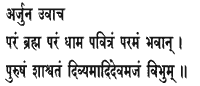
Arjuna said: Thou art the supreme Brahman, the supreme Abode, the supreme Purity, the one permanent, the divine Purusha, the original Godhead, the Unborn, the all-pervading Lord.
The Gist of the Karmayoga
Sri Aurobindo
THE FIRST six chapters of the Gita form a sort of preliminary block of the teaching; all the rest, all the other twelve chapters are the working out of certain unfinished figures in this block which here are seen only as hints behind the large-size execution of the main motives, yet are in themselves of capital importance and are therefore reserved for a yet larger treatment on the other two faces of the work. If the Gita were not a great written Scripture which must be carried to its end, if it were actually a discourse by a living teacher to a disciple which could be resumed in good time, when the disciple was ready for farther truth, one could conceive of his stopping here at the end of the sixth chapter and saying, “Work this out first, there is plenty for you to do to realise it and you have the largest possible basis; as difficulties arise, they will solve themselves or I will solve them for you. But at present live out what I have told you; work in this spirit.” True, there are many things here which cannot be properly understood except in the light thrown on them by what is to come after. In order to clear up immediate difficulties and obviate possible misunderstandings, I have had myself to anticipate a good deal, to bring in repeatedly, for example, the idea of the Purushottama, for without that it would have been impossible to clear up certain obscurities about the Self and action and the Lord of action, which the Gita deliberately accepts so that it may not disturb the firmness of the first steps by reaching out prematurely to things too great as yet for the mind of the human disciple. Arjuna, himself, if the Teacher were to break off his discourse here, might well object: “You have spoken much of the destruction of desire and attachment, of equality, of the conquest of the senses and the stilling of the mind, of passionless and impersonal action, of the sacrifice of works, of the inner as preferable to the outer renunciation, and these things I understand intellectually, however difficult they may appear to me in practice. But you have also spoken of rising above the gunas, while yet one remains in action, and you have not told me how the gunas work, and unless I know that, it will be difficult for me to detect and rise above them. Besides, you have spoken of bhakti as the greatest element in Yoga, yet you have talked much of works and knowledge, but very little or nothing of bhakti. And to whom is bhakti, this greatest thing, to be offered? Not to the still impersonal Self, certainly, but to you, the Lord. Tell me, then, what you are, who, as bhakti is greater even than this self-knowledge, are greater than the immutable Self, which is yet itself greater than mutable Nature and the world of action, even as knowledge is greater than works. What is the relation between these three things? between works and knowledge and divine love? between the soul in Nature and the immutable Self and that which is at once the changeless Self of all and the Master of knowledge and love and works, the supreme Divinity who is here with me in this great battle and massacre, my charioteer in the chariot of this fierce and terrible action?” It is to answer these questions that the rest of the Gita is written, and in a complete intellectual solution they have indeed to be taken up without delay and resolved. But in actual s ¯adhan¯a one has to advance from stage to stage, leaving many things, indeed the greatest things to arise subsequently and solve themselves fully by the light of the advance we have made in spiritual experience. The Gita follows to a certain extent this curve of experience and puts first a sort of large preliminary basis of works and knowledge which contains an element leading up to bhakti and to a greater knowledge, but not yet fully arriving. The six chapters present us with that basis. We may then pause to consider how far they have carried the solution of the original problem with which the Gita started. The problem in itself, it may be useful again to remark, need not necessarily have led up to the whole question of the nature of existence and of the replacement of the normal by the spiritual life. It might have been dealt with on a pragmatical or an ethical basis or from an intellectual or an ideal standpoint or by a consideration of all of these together; that in fact would have been our modern method of solving the difficulty. By itself it raises in the first instance just this question, whether Arjuna should be governed by the ethical sense of personal sin in slaughter or by the consideration equally ethical of his public and social duty, the defence of the Right, the opposition demanded by conscience from all noble natures to the armed forces of injustice and oppression? That question has been raised in our own time and the present hour, and it can be solved, as we solve it now, by one or other of very various solutions, but all from the standpoint of our normal life and our normal human mind. It may be answered as a question between the personal conscience and our duty to the society and the State, between an ideal and a practical morality, between “soul-force” and the recognition of the troublesome fact that life is not yet at least all soul and that to take up arms for the right in a physical struggle is sometimes inevitable. All these solutions are, however, intellectual, temperamental, emotional; they depend upon the individual standpoint and are at the best our own proper way of meeting the difficulty offered to us, proper because suitable to our nature and the stage of our ethical and intellectual evolution, the best we can, with the light we have, see and do; it leads to no final solution. And this is so because it proceeds from the normal mind which is always a tangle of various tendencies of our being and can only arrive at a choice or an accommodation between them, between our reason, our ethical being, our dynamic needs, our life-instincts, our emotional being and those rarer movements which we may perhaps call soul-instincts or psychical preferences. The Gita recognises that from this standpoint there can be no absolute, only an immediate practical solution and, after offering to Arjuna from the highest ideals of his age just such a practical solution, which he is in no mood to accept and indeed is evidently not intended to accept, it proceeds to quite a different standpoint and to quite another answer. The Gita’s solution is to rise above our natural being and normal mind, above our intellectual and ethical perplexities into another consciousness with another law of being and therefore another standpoint for our action; where personal desire and personal emotions no longer govern it; where the dualities fall away; where the action is no longer our own and where therefore the sense of personal virtue and personal sin is exceeded; where the universal, the impersonal, the divine spirit works out through us its purpose in the world; where we are ourselves by a new and divine birth changed into being of that Being, consciousness of that Consciousness, power of that Power, bliss of that Bliss, and, living no longer in our lower nature, have no works to do of our own, no personal aim to pursue of our own, but if we do works at all,—and that is the one real problem and difficulty left,— do only the divine works, those of which our outward nature is only a passive instrument and no longer the cause, no longer provides the motive; for the motive-power is above us in the will of the Master of our works. And this is presented to us as the true solution, because it goes back to the real truth of our being and to live according to the real truth of our being is evidently the highest solution and the sole entirely true solution of the problems of our existence. Our mental and vital personality is a truth of our natural existence, but a truth of the ignorance, and all that attaches itself to it is also truth of that order, practically valid for the works of the ignorance, but no longer valid when we get back to the real truth of our being. But how can we actually be sure that this is the truth? We cannot so long as we remain satisfied with our ordinary mental experience; for our normal mental experience is wholly that of this lower nature full of the ignorance. We can only know this greater truth by living it, that is to say, by passing beyond the mental into the spiritual experience, by Yoga. For the living out of spiritual experience until we cease to be mind and become spirit, until, liberated from the imperfections of our present nature, we are able to live entirely in our true and divine being is what in the end we mean by Yoga. This upward transference of our centre of being and the consequent transformation of our whole existence and consciousness, with a resultant change in the whole spirit and motive of our action, the action often remaining precisely the same in all its outward appearances, makes the gist of the Gita’s Karmayoga. Change your being, be reborn into the spirit and by that new birth proceed with the action to which the Spirit within has appointed you, may be said to be the heart of its message. Or again, put otherwise, with a deeper and more spiritual import, —make the work you have to do here your means of inner spiritual rebirth, the divine birth, and, having become divine, do still divine works as an instrument of the Divine for the leading of the peoples. Therefore there are here two things which have to be clearly laid down and clearly grasped, the way to the change, to this upward transference, this new divine birth, and the nature of the work or rather the spirit in which it has to be done, since the outward form of it need not at all change, although really its scope and aim become quite different. But these two things are practically the same, for the elucidation of one elucidates the other. The spirit of our action arises from the nature of our being and the inner foundation it has taken, but also this nature is itself affected by the trend and spiritual effect of our action; a very great change in the spirit of our works changes the nature of our being and alters the foundation it has taken; it shifts the centre of conscious force from which we act. If life and action were entirely illusory, as some would have it, if the Spirit had nothing to do with works or life, this would not be so; but the soul in us develops itself by life and works and, not indeed so much the action itself, but the way of our soul’s inner force of working determines its relations to the Spirit. This is, indeed, the justification of Karmayoga as a practical means of the higher self-realisation. We start from this foundation that the present inner life of man, almost entirely dependent as it is upon his vital and physical nature, only lifted beyond it by a limited play of mental energy, is not the whole of his possible existence, not even the whole of his present real existence. There is within him a hidden Self, of which his present nature is either only an outer appearance or is a partial dynamic result. The Gita seems throughout to admit its dynamic reality and not to adopt the severer view of the extreme Vedantists that it is only an appearance, a view which strikes at the very roots of all works and action. Its way of formulating this element of its philosophical thought,—it might be done in a different way,—is to admit the Sankhya distinction between the Soul and Nature, the power that knows, supports and informs and the power that works, acts, provides all the variations of instrument, medium and process. Only it takes the free and immutable Soul of the Sankhyas, calls it in Vedantic language the one immutable omnipresent Self or Brahman, and distinguishes it from this other soul involved in Nature, which is our mutable and dynamic being, the multiple soul of things, the basis of variation and personality. But in what then consists this action of Nature? It consists in a power of process, Prakriti, which is the interplay of three fundamental modes of its working, three qualities, gunas. And what is the medium? It is the complex system of existence created by a graded evolution of the instruments of Prakriti, which, as they are reflected here in the soul’s experience of her workings, we may call successively the reason and the ego, the mind, the senses and the elements of material energy which are the basis of its forms. These are all mechanical, a complex engine of Nature, yantra; and from our modern point of view we may say that they are all involved in material energy and manifest themselves in it as the soul in Nature becomes aware of itself by an upward evolution of each instrument, but in the inverse order to that which we have stated, matter first, then sensation, then mind, next reason, last spiritual consciousness. Reason, which is at first only preoccupied with the workings of Nature, may then detect their ultimate character, may see them only as a play of the three gunas in which the soul is entangled, may distinguish between the soul and these workings; then the soul gets a chance of disentangling itself and of going back to its original freedom and immutable existence. In Vedantic language, it sees the spirit, the being; it ceases to identify itself with the instruments and workings of Nature, with its becoming; it identifies itself with its true Self and being and recovers its immutable spiritual self-existence. It is then from this spiritual self-existence, according to the Gita, that it can freely and as the master of its being, the Ishwara, support the action of its becoming. Looking only at the psychological facts on which these philosophical distinctions are founded,—philosophy is only a way of formulating to ourselves intellectually in their essential significance the psychological and physical facts of existence and their relation to any ultimate reality that may exist,—we may say that there are two lives we can lead, the life of the soul engrossed in the workings of its active nature, identified with its psychological and physical instruments, limited by them, bound by its personality, subject to Nature, and the life of the Spirit, superior to these things, large, impersonal, universal, free, unlimited, transcendent, supporting with an infinite equality its natural being and action, but exceeding them by its freedom and infinity.We may live in what is now our natural being or we may live in our greater and spiritual being. This is the first great distinction on which the Karmayoga of the Gita is founded. The whole question and the whole method lie then in the liberation of the soul from the limitations of our present natural being. In our natural life the first dominating fact is our subjection to the forms of material Nature, the outward touches of things. These present themselves to our life through the senses, and the life through the senses immediately returns upon these objects to seize upon them and deal with them, desires, attaches itself, seeks for results. The mind in all its inner sensations, reactions, emotions, habitual ways of perceiving, thinking and feeling obeys this action of the senses; the reason too carried away by the mind gives itself up to this life of the senses, this life in which the inner being is subject to the externality of things and cannot for a moment really get above it or outside the circle of its action upon us and its psychological results and reactions within us. It cannot get beyond them because there is the principle of ego by which the reason differentiates the sum of the action of Nature upon our mind, will, sense, body from her action in other minds, wills, nervous organisms, bodies; and life to us means only the way she affects our ego and the way our ego replies to her touches.We know nothing else, we seem to be nothing else; the soul itself seems then only a separate mass of mind, will, emotional and nervous reception and reaction. We may enlarge our ego, identify ourselves with the family, clan, class, country, nation, humanity even, but still the ego remains in all these disguises the root of our actions, only it finds a larger satisfaction of its separate being by these wider dealings with external things. What acts in us is still the will of the natural being seizing upon the touches of the external world to satisfy the different phases of its personality, and the will in this seizing is always a will of desire and passion and attachment to our works and their results, the will of Nature in us; our personal will, we say, but our ego personality is a creation of Nature, it is not and cannot be our free self, our independent being. The whole is the action of the modes of Nature. It may be a tamasic action, and then we have an inert personality subject to and satisfied with the mechanical round of things, incapable of any strong effort at a freer action and mastery. Or it may be the rajasic action, and then we have the restless active personality which throws itself upon Nature and tries to make her serve its needs and desires, but does not see that its apparent mastery is a servitude, since its needs and desires are those of Nature, and while we are subject to them, there can be for us no freedom. Or it may be a sattwic action, and then we have the enlightened personality which tries to live by reason or to realise some preferred ideal of good, truth or beauty; but this reason is still subject to the appearances of Nature and these ideals are only changing phases of our personality in which we find in the end no sure rule or permanent satisfaction. We are still carried on a wheel of mutation, obeying in our circlings through the ego some Power within us and within all this, but not ourselves that Power or in union and communion with it. Still there is no freedom, no real mastery. Yet freedom is possible. For that we have to get first away into ourselves from the action of the external world upon our senses; that is to say, we have to live inwardly and be able to hold back the natural running of the senses after their external objects. A mastery of the senses, an ability to do without all that they hanker after, is the first condition of the true soullife; only so can we begin to feel that there is a soul within us which is other than the mutations of mind in its reception of the touches of outward things, a soul which in its depths goes back to something self-existent, immutable, tranquil, selfpossessed, grandiose, serene and august, master of itself and unaffected by the eager runnings of our external nature. But this cannot be done so long as we are subject to desire. For it is desire, the principle of all our superficial life, which satisfies itself with the life of the senses and finds its whole account in the play of the passions.We must get rid then of desire and, that propensity of our natural being destroyed, the passions which are its emotional results will fall into quietude; for the joy and grief of possession and of loss, success and failure, pleasant and unpleasant touches, which entertain them, will pass out of our souls. A calm equality will then be gained. And since we have still to live and act in the world and our nature in works is to seek for the fruits of our works, we must change that nature and do works without attachment to their fruits, otherwise desire and all its results remain. But how can we change this nature of the doer of works in us? By dissociating works from ego and personality, by seeing through the reason that all this is only the play of the gunas of Nature, and by dissociating our soul from the play, by making it first of all the observer of the workings of Nature and leaving those works to the Power that is really behind them, the something in Nature which is greater than ourselves, not our personality, but the Master of the universe. But the mind will not permit all this; its nature is to run out after the senses and carry the reason and will with it. Then we must learn to still the mind. We must attain that absolute peace and stillness in which we become aware of the calm, motionless, blissful Self within us which is eternally untroubled and unaffected by the touches of things, is sufficient to itself and finds there alone its eternal satisfaction. This Self is our self-existent being. It is not limited by our personal existence. It is the same in all existences, pervasive, equal to all things, supporting the whole universal action with its infinity, but unlimited by all that is finite, unmodified by the changings of Nature and personality. When this Self is revealed within us, when we feel its peace and stillness, we can grow into that; we can transfer the poise of our soul from its lower immergence in Nature and draw it back into the Self. We can do this by the force of the things we have attained, calm, equality, passionless impersonality. For as we grow in these things, carry them to their fullness, subject all our nature to them, we are growing into this calm, equal, passionless, impersonal, allpervading Self. Our senses fall into that stillness and receive the touches of the world on us with a supreme tranquillity; our mind falls into stillness and becomes the calm, universal witness; our ego dissolves itself into this impersonal existence. All things we see in this self which we have become in ourself; and we see this self in all; we become one being with all beings in the spiritual basis of their existence. By doing works in this selfless tranquillity and impersonality, our works cease to be ours, cease to bind or trouble us with their reactions. Nature and her gunas weave the web of her works, but without affecting our griefless self-existent tranquillity. All is given up into that one equal and universal Brahman. But here there are two difficulties. First, there seems to be an antinomy between this tranquil and immutable Self and the action of Nature. How then does the action at all exist or how can it continue once we have entered into the immutable Selfexistence? Where in that is the will to works which would make the action of our nature possible? If we say with the Sankhya that the will is in Nature and not in the Self, still there must be a motive in Nature and the power in her to draw the soul into its workings by interest, ego and attachment, and when these things cease to reflect themselves in the soul-consciousness, her power ceases and the motive of works ceases with it. But the Gita does not accept this view, which seems indeed to necessitate the existence of many Purushas and not one universal Purusha, otherwise the separate experience of the soul and its separate liberation while millions of others are still involved, would not be intelligible. Nature is not a separate principle, but the power of the Supreme going forth in cosmic creation. But if the Supreme is only this immutable Self and the individual is only something that has gone forth from him in the Power, then the moment it returns and takes its poise in the self, everything must cease except the supreme unity and the supreme calm. Secondly, even if in some mysterious way action still continues, yet since the Self is equal to all things, it cannot matter whether works are done or, if they are done, it cannot matter what work is done. Why then this insistence on the most violent and disastrous form of action, this chariot, this battle, this warrior, this divine charioteer? The Gita answers by presenting the Supreme as something greater even than the immutable Self, more comprehensive, one who is at once this Self and theMaster of works in Nature. But he directs the works of Nature with the eternal calm, the equality, the superiority to works and personality which belong to the immutable. This, we may say, is the poise of being from which he directs works, and by growing into this we are growing into his being and into the poise of divine works. From this he goes forth as the Will and Power of his being in Nature, manifests himself in all existences, is born as Man in the world, is there in the heart of all men, reveals himself as the Avatar, the divine birth in man; and as man grows into his being, it is into the divine birth that he grows. Works must be done as a sacrifice to this Lord of our works, and we must by growing into the Self realise our oneness with him in our being and see our personality as a partial manifestation of him in Nature. One with him in being, we grow one with all beings in the universe and do divine works, not as ours, but as his workings through us for the maintenance and leading of the peoples. This is the essential thing to be done, and once this is done, the difficulties which present themselves to Arjuna will disappear. The problem is no longer one of our personal action, for that which makes our personality becomes a thing temporal and subordinate, the question is then only one of the workings of the divine Will through us in the universe. To understand that we must know what this supreme Being is in himself and in Nature, what the workings of Nature are and what they lead to, and the intimate relation between the soul in Nature and this supreme Soul, of which bhakti with knowledge is the foundation. The elucidation of these questions is the subject of the rest of the Gita.
END OF THE FIRST SERIES
Sri Aurobindo
 About Us | ©1999 - 2009 searchforlight.org
All extracts and quotations from the written works of Sri Aurobindo and the Mother and the Photographs of
the Mother and Sri Aurobindo are copyright Sri Aurobindo Ashram Trust, Pondicherry -605002 India.